> ## Documentation Index
> Fetch the complete documentation index at: https://docs.arcx.trade/llms.txt
> Use this file to discover all available pages before exploring further.
# vToken
> The base vault share. Deposit USDC, earn yield, and accrue credits for supported reward programs.
## What Is a vToken
A vToken is a vault share. Each vault pairs a market maker with one or more perp DEXes. You deposit USDC, receive vToken shares, and get two forms of exposure:
1. **Yield** — the market maker borrows your capital and returns value through either a fixed rate or a performance-fee split
2. **Credits** — the strategy's activity participates in supported reward programs, and your holding time accrues credits that generate CreditTokens
One vToken per vault. Different vaults have different market makers, exchanges, and rates.
vToken is the simplest way to use ArcX. You earn yield and accrue credits without trading or managing anything. Just deposit and hold.
***
## Deposit
Deposit USDC into a vault. You receive vToken shares at the current NAV:
$\text{shares} = \frac{\text{deposit amount}}{\text{NAV}}$
First deposit into an empty vault mints shares 1:1 with USDC. After that, shares are priced by NAV.
***
## Yield
Yield comes from the market maker borrowing vault capital and returning value through either a fixed rate or a performance-fee split. NAV tracks that value over time.
NAV only reflects hard assets (USDC value). It does not price in points — points are tracked separately through credits.
***
## Credits and CreditTokens
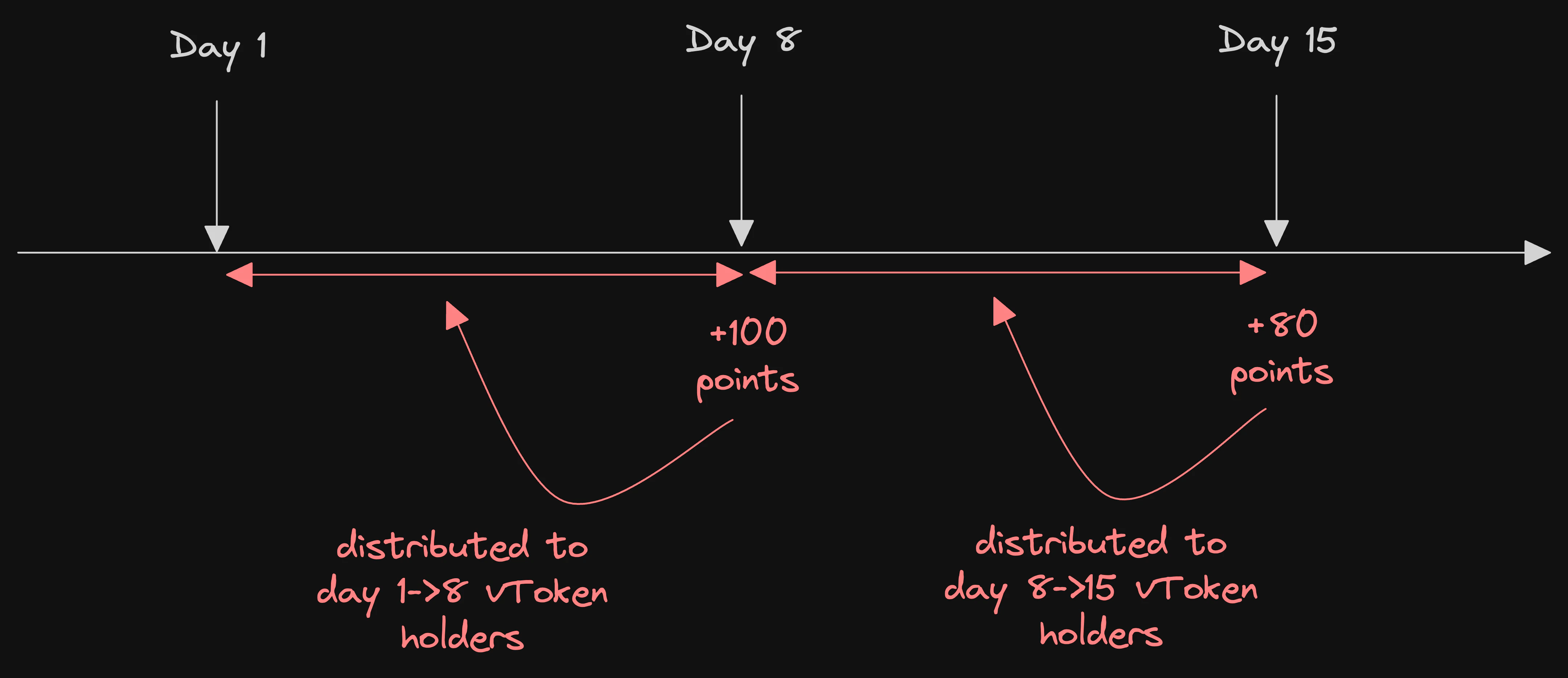
Your vToken accrues **credits** while you hold it — the longer you hold and the more you hold, the bigger your share of CreditTokens for each period. Credits are tracked automatically on-chain.
Each period, CreditTokens are minted based on credit share and the period weight reported through the oracle. Market makers can share rewards received from the underlying protocol with CreditToken holders.
Hold earlier, earn more. Earlier credit periods are locked in and cannot be diluted by later depositors.
 If you buy vTokens on secondary or receive them via transfer, your credit counter starts from zero. The previous holder keeps their accumulated credits.
See [Credit Mathematics](/deep-dives/credit-mathematics) for the formula.
***
## Withdrawal
Withdrawals depend on two timing constraints: **lock-in** and **unwinding**.
Operators usually need deposits to stay on the exchange for a minimum period so they can put the capital to work. Because of that, each vToken has a global lock-in window.
If the lock-in is 3 days, then the withdrawable amount is total supply minus deposits made in the last 3 days. During this lock-in period, your vTokens are **not** burned, and you continue earning yield and credits.
Once your position is withdrawable, the operator still needs time to unwind exchange positions and return capital to the vault contract. Your vTokens are burned during this unwinding period.
After unwinding completes, the USDC is available to withdraw from the vault.
You can find the current lock-in time and unwinding time on the market page.
If you buy vTokens on secondary or receive them via transfer, your credit counter starts from zero. The previous holder keeps their accumulated credits.
See [Credit Mathematics](/deep-dives/credit-mathematics) for the formula.
***
## Withdrawal
Withdrawals depend on two timing constraints: **lock-in** and **unwinding**.
Operators usually need deposits to stay on the exchange for a minimum period so they can put the capital to work. Because of that, each vToken has a global lock-in window.
If the lock-in is 3 days, then the withdrawable amount is total supply minus deposits made in the last 3 days. During this lock-in period, your vTokens are **not** burned, and you continue earning yield and credits.
Once your position is withdrawable, the operator still needs time to unwind exchange positions and return capital to the vault contract. Your vTokens are burned during this unwinding period.
After unwinding completes, the USDC is available to withdraw from the vault.
You can find the current lock-in time and unwinding time on the market page.